
Print Date : 27 October 2026 ||
Published Date : 22 April 2026
Bangladesh Faces Critical Contraceptive Shortage, Family Planning at Risk
 Metro24News, Personal Correspondent ||
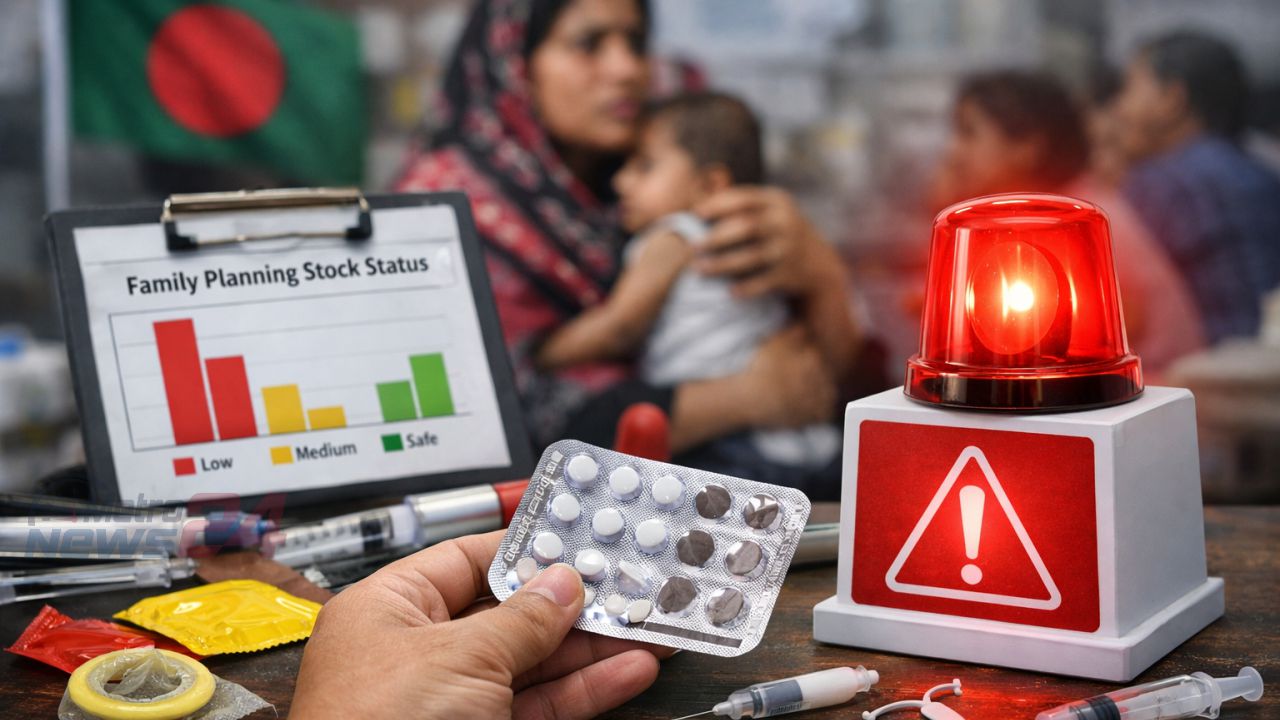
Bangladesh’s long-celebrated success in family planning is now facing a serious setback, as widespread shortages of contraceptives and essential maternal health supplies push the system into what experts describe as a “red alert” situation.Due to alleged negligence, lack of attention, and poor coordination by the concerned ministry and departments, the country’s birth control system is on the brink of collapse. Stocks of key contraceptive methods—including condoms, oral pills, implants, and intrauterine devices (IUDs)—have nearly run out across most parts of the country.According to the Supply Chain Management Portal (SCMP) monitoring dashboard of the Directorate General of Family Planning (DGFP), almost all upazilas are currently marked with a “red” signal, indicating critically low or near-zero stock levels.Md. Abdur Razzaq, Director (Logistics and Supply) of DGFP, explained that a red signal denotes either no stock or less than three months’ supply, while yellow indicates three to five and a half months, and green signifies more than six months of stock.An analysis of the SCMP dashboard shows that this crisis has intensified over the past one and a half years—an alarming and unusual trend.Widespread Shortages Across the CountryThe latest DGFP data reveals alarming gaps in availability:Condoms are unavailable in 394 upazilasOral contraceptive pills are out of stock in 337 upazilasEmergency contraceptive pills (ECP) are absent in 468 upazilasImplants are unavailable in 358 upazilasIUDs are out of stock in 392 upazilasInjectable contraceptives are unavailable in 271 upazilasAdditionally, essential maternal health supplies—including misoprostol, oxytocin, iron-folic acid, and magnesium sulfate—are also nearly depleted nationwide.As of April 20, current national stock levels are critically low:Condoms: 1.795 million units (approximately 36 days’ supply)Oral pills: 2.963 million units (around 40 days’ supply)IUDs: 16,000 units (about two months’ supply)Injectables: 1.013 million units (roughly two months’ supply)Implants: Completely out of stockWhy Has the Crisis Persisted?Officials, development partners, and public health experts attribute the prolonged shortage primarily to policy disruptions.Previously, procurement of contraceptives and maternal health supplies was conducted under the Health, Population, and Nutrition Sector Program (HPNSP) through operational plans (OPs). However, the interim government abruptly discontinued these OPs in 2025.This led to delays in preparing new project documents, approvals, appointments of project directors, and fund disbursement.DGFP Director General Ashrafi Ahmed stated that the crisis began in late 2023 when a major procurement proposal was not approved. The situation worsened after the OP system was halted in June 2024, effectively stalling procurement activities. By 2025, the shortage had become severe.He added that completing a procurement cycle takes at least 120 days, which could not be initiated on time. Efforts are currently underway to supply limited quantities from revenue funds, and authorities আশা that necessary supplies will arrive by May.Dr. Monjur Ahmed, focal person of the MCH Services Unit, noted that no major procurement has taken place in the past two years, nor has sufficient funding been allocated. Even under emergency measures, it would take two to two and a half months to receive supplies due to government procurement regulations.Describing the situation, he said, “If you log into the SCMP dashboard, everything is red. In simple terms—just write two letters: all red.”He warned that even a one-month disruption in supply chains results in significant economic loss, estimating that every dollar lost in supply translates into a $14 loss in investment returns.Rising Fertility Rate Signals ReversalExperts warn that Bangladesh may be reversing its decades-long progress in population control.According to the Health Reform Commission, the country’s total fertility rate (TFR) declined from 5.07 in 1981 to 2.3 in 2012, remaining stable until 2022. However, the latest Multiple Indicator Cluster Survey (MICS) 2025 by the Bangladesh Bureau of Statistics (BBS) and UNICEF shows that TFR has risen to 2.4.This increase is closely linked to reduced contraceptive availability, particularly in rural areas where people depend heavily on government supplies.Professor Mohammad Mainul Islam of the Population Sciences Department at the University of Dhaka stated that declining contraceptive use and rising fertility rates clearly indicate a breakdown in grassroots family planning services.He warned that low-income populations will be the hardest hit, as many cannot afford to purchase contraceptives privately, increasing the risk of unintended pregnancies.Serious Public Health Risks AheadPublic health experts caution that prolonged shortages could undermine Bangladesh’s demographic dividend and lead to a surge in unsafe abortions and maternal health risks.Professor Dr. Benazir Ahmed, former Director of Disease Control at the Directorate General of Health Services, described the situation as a “major disruption” caused by abrupt policy decisions during the interim government period.“The sudden suspension of operational plans severely disrupted ongoing health programs, including family planning,” he said. “Years of progress are now at risk.”He further warned that the lack of contraceptive supplies is increasing the likelihood of unintended pregnancies and unsafe abortion practices, posing serious threats to women’s health and lives.
Metro24News, Personal Correspondent ||
Bangladesh’s long-celebrated success in family planning is now facing a serious setback, as widespread shortages of contraceptives and essential maternal health supplies push the system into what experts describe as a “red alert” situation.Due to alleged negligence, lack of attention, and poor coordination by the concerned ministry and departments, the country’s birth control system is on the brink of collapse. Stocks of key contraceptive methods—including condoms, oral pills, implants, and intrauterine devices (IUDs)—have nearly run out across most parts of the country.According to the Supply Chain Management Portal (SCMP) monitoring dashboard of the Directorate General of Family Planning (DGFP), almost all upazilas are currently marked with a “red” signal, indicating critically low or near-zero stock levels.Md. Abdur Razzaq, Director (Logistics and Supply) of DGFP, explained that a red signal denotes either no stock or less than three months’ supply, while yellow indicates three to five and a half months, and green signifies more than six months of stock.An analysis of the SCMP dashboard shows that this crisis has intensified over the past one and a half years—an alarming and unusual trend.Widespread Shortages Across the CountryThe latest DGFP data reveals alarming gaps in availability:Condoms are unavailable in 394 upazilasOral contraceptive pills are out of stock in 337 upazilasEmergency contraceptive pills (ECP) are absent in 468 upazilasImplants are unavailable in 358 upazilasIUDs are out of stock in 392 upazilasInjectable contraceptives are unavailable in 271 upazilasAdditionally, essential maternal health supplies—including misoprostol, oxytocin, iron-folic acid, and magnesium sulfate—are also nearly depleted nationwide.As of April 20, current national stock levels are critically low:Condoms: 1.795 million units (approximately 36 days’ supply)Oral pills: 2.963 million units (around 40 days’ supply)IUDs: 16,000 units (about two months’ supply)Injectables: 1.013 million units (roughly two months’ supply)Implants: Completely out of stockWhy Has the Crisis Persisted?Officials, development partners, and public health experts attribute the prolonged shortage primarily to policy disruptions.Previously, procurement of contraceptives and maternal health supplies was conducted under the Health, Population, and Nutrition Sector Program (HPNSP) through operational plans (OPs). However, the interim government abruptly discontinued these OPs in 2025.This led to delays in preparing new project documents, approvals, appointments of project directors, and fund disbursement.DGFP Director General Ashrafi Ahmed stated that the crisis began in late 2023 when a major procurement proposal was not approved. The situation worsened after the OP system was halted in June 2024, effectively stalling procurement activities. By 2025, the shortage had become severe.He added that completing a procurement cycle takes at least 120 days, which could not be initiated on time. Efforts are currently underway to supply limited quantities from revenue funds, and authorities আশা that necessary supplies will arrive by May.Dr. Monjur Ahmed, focal person of the MCH Services Unit, noted that no major procurement has taken place in the past two years, nor has sufficient funding been allocated. Even under emergency measures, it would take two to two and a half months to receive supplies due to government procurement regulations.Describing the situation, he said, “If you log into the SCMP dashboard, everything is red. In simple terms—just write two letters: all red.”He warned that even a one-month disruption in supply chains results in significant economic loss, estimating that every dollar lost in supply translates into a $14 loss in investment returns.Rising Fertility Rate Signals ReversalExperts warn that Bangladesh may be reversing its decades-long progress in population control.According to the Health Reform Commission, the country’s total fertility rate (TFR) declined from 5.07 in 1981 to 2.3 in 2012, remaining stable until 2022. However, the latest Multiple Indicator Cluster Survey (MICS) 2025 by the Bangladesh Bureau of Statistics (BBS) and UNICEF shows that TFR has risen to 2.4.This increase is closely linked to reduced contraceptive availability, particularly in rural areas where people depend heavily on government supplies.Professor Mohammad Mainul Islam of the Population Sciences Department at the University of Dhaka stated that declining contraceptive use and rising fertility rates clearly indicate a breakdown in grassroots family planning services.He warned that low-income populations will be the hardest hit, as many cannot afford to purchase contraceptives privately, increasing the risk of unintended pregnancies.Serious Public Health Risks AheadPublic health experts caution that prolonged shortages could undermine Bangladesh’s demographic dividend and lead to a surge in unsafe abortions and maternal health risks.Professor Dr. Benazir Ahmed, former Director of Disease Control at the Directorate General of Health Services, described the situation as a “major disruption” caused by abrupt policy decisions during the interim government period.“The sudden suspension of operational plans severely disrupted ongoing health programs, including family planning,” he said. “Years of progress are now at risk.”He further warned that the lack of contraceptive supplies is increasing the likelihood of unintended pregnancies and unsafe abortion practices, posing serious threats to women’s health and lives. Publisher & Editor: MAJEDUR RAHMAN Copyright © Metro 24 News
 Print
Print
 Save
Save